
Overgrown nails are a common reason to visit the vet. But it can be done at home! The right equipment, combined with an understanding of your dog’s nail anatomy, can help you avoid issues and save time by doing this at home. It’s important to not let your dog’s nails get too overgrown. Overgrown nails can eventually curve around and start digging into the paw pad, which is very painful and can even lead to infections. Long nails can also make it more uncomfortable for your dog to walk and are, therefore, a welfare issue too.
Overgrown nails cannot be cut back in one big trim, so it’s best to trim them little and often to keep them nice and short. The first time you plan to cut your dog’s nails, it could be worth getting them done at the groomers or with a veterinary nurse. They could demonstrate how to cut your dog’s nails and train you to do it at home. This article will go through how to prepare for a successful nail clip, how to trim the nails, and what to do if something goes wrong.
Before you cut their nails:
Trimming your dog’s nails can be a workout, but there are certain things you can do to prepare for a successful attempt. Training your dog from a young age to tolerate nail clippers is the best way to ensure they accept clipping in the future. Even just the sound of clipping can upset some dogs, so it is worth conditioning them beforehand. Treat-based training is often the best way to do this.
Having another person around to restrain or distract your dog can be very helpful. Your dog may not even know what’s going on if they have someone else dangling a treat in front of their face. If you can’t find a pair of spare hands, licking mats with a teaspoon of peanut butter on them can work a treat to keep them distracted.
Finally, the nail clippers themselves need to be the right size. There is no point trying to use a pair of cat nail scissors on your 70kg Rottweiler. Most nail clipper brands will state the size or weight of the dog they are suitable for. Human nail clippers will also not work!
How to cut your dog’s nails
Start by getting yourself into a comfortable position, pick up your clippers and with the other hand pick up your dog’s paw. You should be able to protrude each digit (toe) individually. This will make it easier to place the clippers over the nail to cut. The main aim when cutting your dog’s nails is to not hit the quick. The quick is the sensitive blood supply to the nail, which runs through the centre of the nail and stops a few millimetres before the tip. The exact distance between the end of the quick and the tip of the nail will be different in every dog and can even be manipulated with regular trimming. Cutting the quick is extremely painful for your dog and can cause bleeding. Experiences like this can often lead to resistance when you next try and cut them.
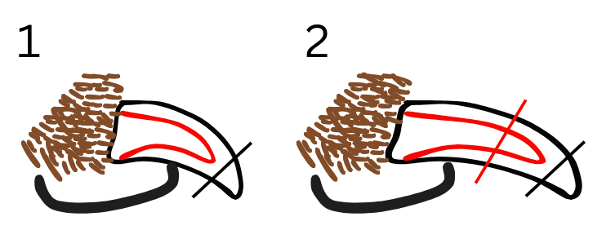
Diagram 1 = where to cut a short nail (black line)
Diagram 2 = where not to cut a long nail (red line) and where to cut a long nail (black line)
If your dog has short nails already, start by cutting a few mm from the tip of the nail. If your dog has white nails, the quick can often be seen as a pale pink structure within the nail. If you can see the quick, always aim to trim the nail well below it. This should leave you with a nice clipped short nail that does not bleed.
However, if your dog has long nails, do not be tempted to cut them back short straight away as this will be painful and cause bleeding. The quick grows with the nail and you want to avoid damaging it. Start by clipping below the quick or a few mm of nail from the tip. Whilst the nail may still be longer than you’d like, this prevents you from hitting the quick and causing damage. You can repeat this perhaps weekly. The quick will recede as the nail is gradually cut back. This is why cutting your dog’s nails little and often is better for maintaining shorter nails.
Tips for black nails
Unfortunately, we are unable to see the quick in black nails, meaning we lose our marker for where to cut the nail. Give a GENTLE squeeze with the clippers before cutting – if your dog flinches, then you’re probably over the quick, and need to move further down the nail. To be safe, less is more. Trim the nail a few mm from the tip and repeat every couple of weeks. This way, you should avoid hitting the quick.
Scratch boards
You can now buy large emery boards online and train your dog to scratch them to file their nails down. Their use requires a bit of reward-based training to get the hang of the right technique, but this doubles up as a form of enrichment for your dog!
Walking your dog on a pavement can be a great way to naturally file down your dog’s nails. The hard surface acts as an emery board that wears away at the tip of the nail. You don’t have to take them out on pavements for every walk, but a couple of walks a week can help to keep them filed down. This means you may get away with having to trim their nails less regularly.
But what could go wrong?
The most likely thing to go wrong is accidentally cutting the quick. Your dog may withdraw their paw, yowl, and the nail could start to bleed. To stop the bleeding, apply pressure to the end of the nail with cotton wool for about 5 minutes. You can buy styptic caustic pencils online designed for canine nail trimming. These can be applied to the end of the nail and should stop the bleeding. If the bleeding persists after half an hour or your dog shows signs of lameness over the next few days, visit your local vet for some pain relief and further assessment.
If your dog is really against you trimming their nails, they may need some behavioural support. Whatever you do, do not pin your dog down just to trim their nails. This is highly stressful for them and poses a risk to your safety and their wellbeing. Take your dog to the vet for further advise. They will be able to suggest behavioural training regimes to condition your dog into tolerating nail clips. They may also offer sedation for a nail clip at the practice.
Cut to the conclusion
Regularly trimming your dog’s nails is essential for their comfort and health. With the right tools, patience, and consistent practice, you can successfully manage your dog’s nails at home. Remember, little and often is the best approach and if you are ever uncertain about how to trim your dog’s nails, your veterinary nurse will be more than happy to help.
Discussion